
Stakeholders
The demands of stakeholders are key to a company's sustainability and success. Chroma ATE Inc. believes that through communication with stakeholders, understanding their needs and expectations, and responding to them, not only can the Company review and plan short-, medium-, and long-term strategies, but it can also create value for stakeholders and open up new business opportunities for sustainable operations.
In accordance with the five dimensions of the AA1000 Stakeholder Engagement Standard 2015 (AA1000 SES)―Dependency, Influence, Responsibility, Diversity of Perspectives, and Tension―stakeholders are identified and key stakeholders are selected based on their importance. This further enables the assessment of the significance of the impact of material topics on economic, environmental, and human rights (social) aspects, serving as a basis for sustainable development strategy planning and as the foundation for the information disclosed in this report. Based on this principle, Chroma's 5 key stakeholders are defined as: customers, employees, suppliers, government and regulatory bodies, and investors (shareholders, Board of Directors, and subsidiaries). Through diverse channels, both regularly and irregularly, engagement is conducted to understand stakeholder expectations. At the same time, this serves as an information source for the assessment of sustainability topics and impacts.
Stakeholder
Investors
(including shareholders,
Board of Directors, etc.)
Importance to Chroma ATE Inc.
Creating stable profitability and investment returns, while demonstrating sustainable governance
performance.
Engagement Methods and Frequency
[Regular]
- Shareholders' Meeting (once a year)
- Board of Directors (5 times in 2025)
- Annual Report (once a year)
- Financial Report (quarterly)
[Irregular]
- Company Website
Stakeholder
Competent authorities
Importance to Chroma ATE Inc.
Compliance with laws and regulations and cooperation with government policies, while responding to stakeholder expectations of Chroma.
Engagement Methods and Frequency
[Irregular]
- Market Observation Post System
- Official correspondence
- Policy briefings
- On-site audits
Stakeholder
Customers
Every piece of customer feedback is essential to Chroma's development and enhancement of customer relationships. Through in-depth understanding of customers' needs and opinions across various dimensions, followed by analysis and review, continuous improvements are facilitated.
Engagement Methods and Frequency
[Regular]
- Internal quality and review meetings
- Customer satisfaction surveys
[Irregular]
- Sales visits
- Various business meetings
- Technical seminars
Stakeholder
Suppliers
Importance to Chroma ATE Inc.
Chroma ATE Inc. builds a mutually beneficial value chain with business partners, strengthens an ESG-balanced cooperative relationship, and jointly creates new business models to enhance sustainable competitiveness.
Engagement Methods and Frequency
[Regular]
- Regular supplier meetings
- Regular audits
- Evaluations and guidance
[Irregular]
- Supplier grievance channels
- Technical seminars
Stakeholder
Employees
Importance to Chroma ATE Inc.
Chroma sincerely cares about employee needs, establishes a friendly work environment, implements hazard identification and risk assessment to reduce potential hazards, and fosters employee cohesion. By continuously optimizing the health check system and improving gender equality measures, Chroma not only cares for employee health but also safeguards employee human rights.
Engagement Methods and Frequency
[Regular]
- Labor-management meetings
- Monthly/weekly meetings at each plant
- Labor representative assemblies
[Irregular]
- Direct supervisors
- Dedicated HR personnel
- Company bulletin boards
- Employee feedback mailboxes
- Employee forums
- Employee grievance channels
- Training coursesand policy briefing sessions
Sharing Experiences and Communicating on Sustainability Topics

- Emerging risks
- Climate action, energy saving and carbon reduction
- Scope 3 Carbon Reduction
- Biodiversity
Based on the risk ranking in the WEF 2025 Global Risks Report, the Company held meetings with relevant departments to explain changes in risk scope. Scenario analysis was conducted to assess the short- and medium-term impacts of global risks on the company to varying degrees. Emerging risks will be incorporated in the annual organizational context and risk assessment in 2026.
The Company regularly participates in carbon reduction and climate-related forums and workshops organized by the competent authority and TAISE, and connects the latest international development trends with its policies, communicates future directions to various departments, and provides executives with up-to-date information for decision- making.
In 2025, the Environmental Protection, Safety & Health Center planned to expand the scope of Scope 3 inventory to include employee commuting for the first time. A digital platform was established to systematically collect commuting data from all employees to build a more complete upstream and downstream greenhouse gas inventory scope.
In cooperation projects with environmental non-profit organizations and national parks, the Company evaluated and analyzed feasible solutions for protecting Taiwan's native species during the meeting. The Company periodically reviews the results of beach cleanups and ecological seminars and adjusts the planning of environmental sustainability and biodiversity initiatives for the following year based on meeting discussions.
Material Topic Analysis and Sustainability Impact Assessment
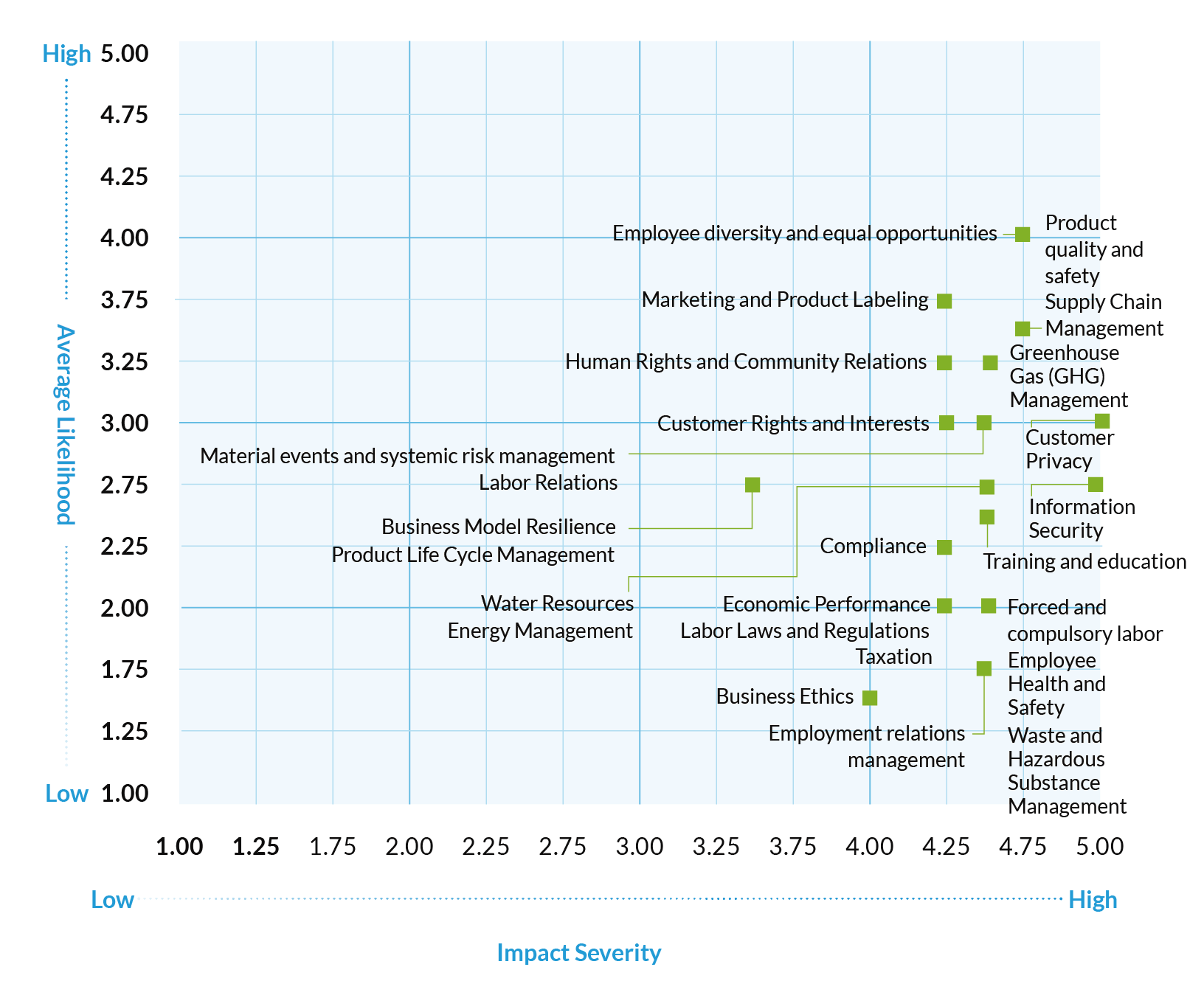
Chroma issued questionnaires to five major stakeholder groups and selected 25 topics with high levels of concern. Chroma's ESG Working Group focused on high-concern topics, scoring them based on the likelihood and significance of their positive and negative impacts, and then screened out 17 material topics. (From 33 sustainability topics to 25 high-concern topics)
Negative Impact
Positive Impact
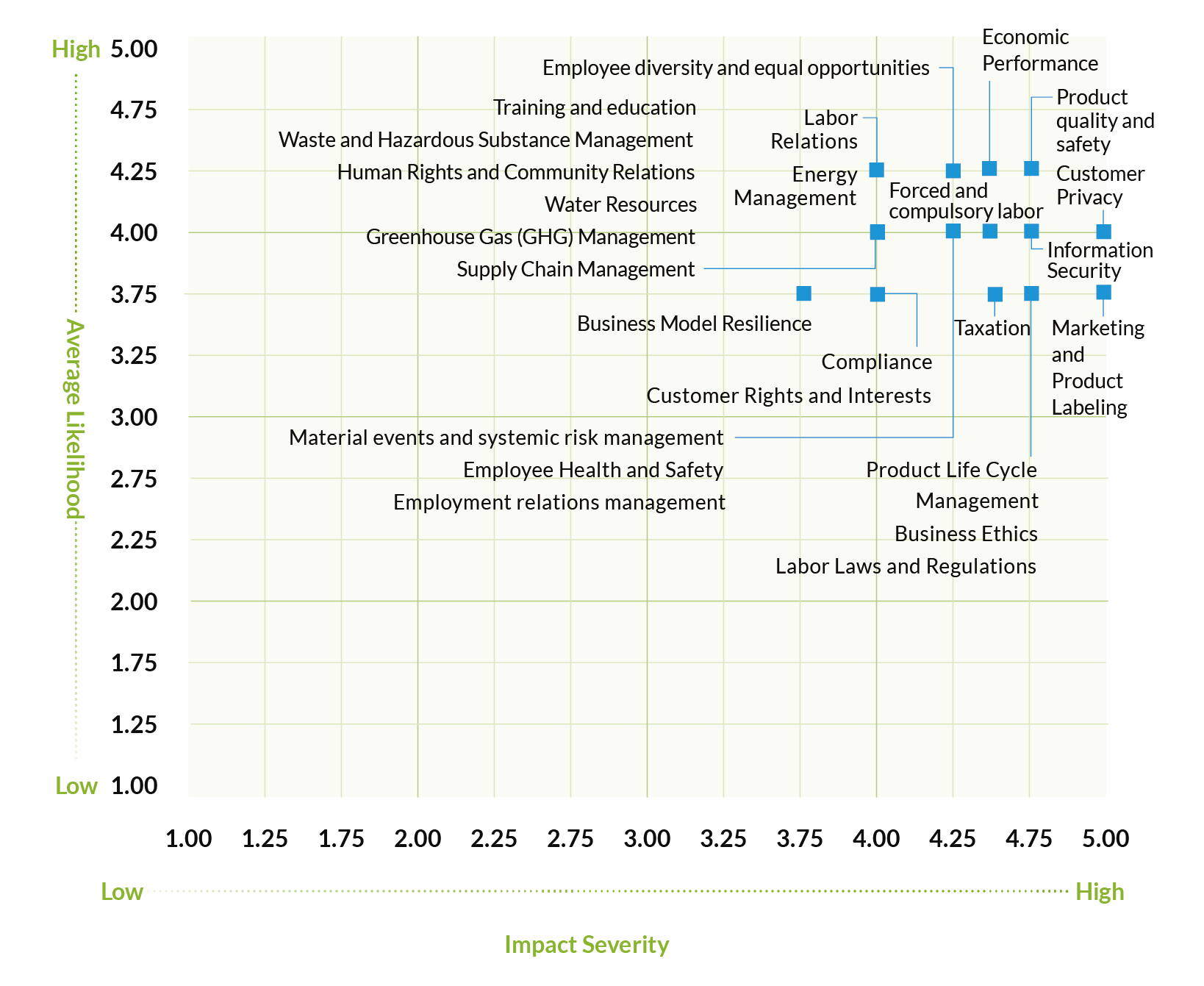
Given the nature of Chroma's operations, the impact and degree of influence from air pollution are minimal, and water resources are primarily used for domestic purposes, with no process wastewater generated during production processes. However, as water resource management is affected by climate change, it remains a key concern for many stakeholders and is therefore included as a material topic. Customer trust and product quality have always been the cornerstone of Chroma's success in the industry; therefore, product quality and safety are included as material topics. During product R&D, the Company enhances customer energy efficiency and improves power consumption to achieve carbon reduction, which is also a goal actively pursued by Chroma. As the risks posed by climate change intensify, managing greenhouse gas emissions and energy consumption becomes a key challenge for the Company. Waste Management was renamed Waste and Hazardous Substance Management and expanded to include source-level management. Among environmental issues, 5 were identified as material topics.
In accordance with Chroma's human rights policy on diversity and equal opportunity in the workplace, Employment Relations Management was newly added, and high-concern international issues, including Human Rights, Community Relations, and Forced and Compulsory Labor, were incorporated. Occupational Safety and Health Management was renamed Employee Health and Safety; Diversity and Equal Opportunities was renamed Employee Diversity and Equal Opportunities; and Talent Development and Training was renamed Training and Education. A total of 7 items were identified as material topics in the social dimension.
In terms of corporate governance, Chroma's ESG Working Group considers that corporate ethics, legal compliance, business model resilience, competitive behavior, and taxation are already embedded in its core business philosophy and are therefore not identified as material topics. Material Events, Systemic Risk Management, Supply Chain Management, Economic Performance, Customer Privacy, and Information Security are regarded as key elements in establishing a comprehensive and sound corporate governance system and implementing sustainable operations. Ultimately, 17 material topics were selected, and the management policies, risk descriptions, and actual results related to these issues were publicly disclosed. Other non-material topics are also disclosed in the Sustainability Report.
17 material topics were identified in 2025.
- Environmental dimension (E): there are 5 topics with relatively high impact: "Water Resources" has been added compared to 2024.
- Social dimension (S): there are 7 topics with relatively high impact: "Employment Relations Management," and "Forced and Compulsory Labor," have been added compared to 2024.
- Governance dimension (G): there are 5 topics with relatively high impact: "Material Events and Systemic Risk Management" has been added compared to 2024.
In the stakeholder questionnaire, Business Ethics, Regulatory Compliance and Ethical Business Practices, and Business Model Resilience received relatively high attention. "Business Ethics, Ethical Business Practices" has been incorporated into its core value. Since its establishment, Chroma ATE Inc. has always regarded "integrity" as a fundamental employee behavioral guideline and core value, which has been fully integrated into the Company's business strategy.
Material Topic
Waste and Hazardous
Substance Management
Positive Actual and Potential Impact on
Chroma
Including measures such as "reducing
waste in the production process" and "using
fewer production fixtures." To reduce
production waste, the production process
and design should be improved to lower
the amount of waste generated during
production while increasing material utilization.
Negative Actual and Potential Impact on
Chroma
- If the Waste Disposal Act or local EPA regulations are violated, this will directly result in administrative fines or even criminal liability.
- As regulations become stricter (e.g., more detailed classifications of hazardous electronic waste), waste disposal costs will increase.
Material Topic
Greenhouse Gas (GHG)
Management
Positive Actual and Potential Impact on
Chroma
Reducing greenhouse gas emissions is a
global environmental protection trend.
Through quantifying greenhouse gas inventory
reports, the Company promotes
emission reduction and control. Setting the
goal of "net-zero emissions at office sites
by 2030; net-zero emissions across all sites
by 2050."
Positive Actual and Potential Impact on
Chroma
- Chroma relies heavily on electricity for testing and production operations. In recent years, rising electricity prices (such as electricity price adjustments in Taiwan and fluctuations in international fuel prices) have directly driven up operating costs.
- In cases of power shortages in summer or policy-driven power restrictions, the Company may be required to limit power usage, affecting production schedules and delivery times, thus directly harming revenue.
Material Topic
Energy Management
Positive Actual and Potential Impact on
Chroma
The Company strives to reduce energy
resource consumption during operations
to achieve the goal of conserving energy
and protecting the planet. Energy resource
management is a key component and driver
of sustainable corporate operations;
institutionalized management promotes
environmental performance and energy
conservation.
Negative Actual and Potential Impact on
Chroma
- Chroma relies heavily on electricity for testing and production operations. In recent years, rising electricity prices (such as electricity price adjustments in Taiwan and fluctuations in international fuel prices) have directly driven up operating costs.
- In cases of power shortages in summer or policy-driven power restrictions, the Company may be required to limit power usage, affecting production schedules and delivery times, thus directly harming revenue.
Material Topic
Water Resources
Positive Actual and Potential Impact on
Chroma
Chroma's water use is primarily for domestic
purposes. By promoting water
conservation and adopting water-saving
equipment, the Company maintains water
efficiency, avoids unnecessary water
waste, and prevents the impact on regional
water resources and the surrounding environment.
The Company continues to monitor
the potential impacts of climate change
on water resource stability. Through the
adoption of robust water management
practices and the cultivation of risk awareness,
it maintains normal operations amid
future uncertainties in water supply and
improves overall operational resilience.
Negative Actual and Potential Impact on
Chroma
- As the Company's water consumption is relatively low, it does not have a significant negative impact on water resources and related ecosystems. However, given that climate change may alter rainfall patterns and increase the frequency of extreme weather events, potential risks remain in the future. Therefore, the Company will continue to monitor the situation and maintain effective water management practices.
Material Topic
Product quality and
safety
Positive Actual and Potential Impact on
Chroma
Chroma ATE Inc. is committed to becoming
a world-class enterprise. While operating
globally, it actively responds to the impacts
of global warming through R&D, manufacturing,
products, and services. The results
of technological innovation are demonstrated
in the excellent performance and
functionality of new products. Green design
is incorporated into all stages of the
product life cycle to reduce environmental
impact and fulfill product and consumer
responsibility.
Negative Actual and Potential Impact on
Chroma
- If a product has quality defects or safety issues, it may lead to increased repair or replacement costs, as well as customer claims, which could adversely affect the Company's operations and brand reputation. In addition, such incidents may also undermine consumer and customer trust in the Company's products, adversely impacting its brand image and market competitiveness, and even impacting customer partnerships.