
Climate Change Risks and Opportunities
In response to the impact of climate change issues, the Company follows the guidelines provided by the Task Force on Climate-related Financial Disclosures (referred to as TCFD) proposed by the Financial Stability Board (FSB). An analysis of the impacts of climate change was conducted by the ESG Working Group. In addition to analyzing the risks brought by climate change and the Company's strategies, it also proposed new products and new market opportunities that the Company can grasp under the climate change in the future. At the same time, Chroma has set the target of "net-zero emissions at office sites by 2030 and net-zero emissions across all facilities by 2050." The Company is working toward this target by conducting inventories of production and office environments, improving manufacturing processes, and promoting green product design, gradually transitioning from low-carbon practices to net-zero emissions.
Governance
1-1 The Board of Directors is the highest governance body of the Company for the management of climate-related risks and opportunities. The Board of Directors is responsible for supervising and reviewing its strategic development and policy formulation, including risk identification and strategy formulation in all aspects of the Company, to ensure that the Company can mitigate future impacts and develop potential opportunities. Director David Huang has been appointed as the person in charge.
1-2 Members of the Board of Directors have a thorough understanding of the importance and impact of climate change. Climate-related issues have already been incorporated into major investment decisions. For example, topics such as carbon management and the use of energy and resources in response to climate change risks are carefully reviewed and discussed to ensure informed decision-making.
Climate Change Governance and Management Framework
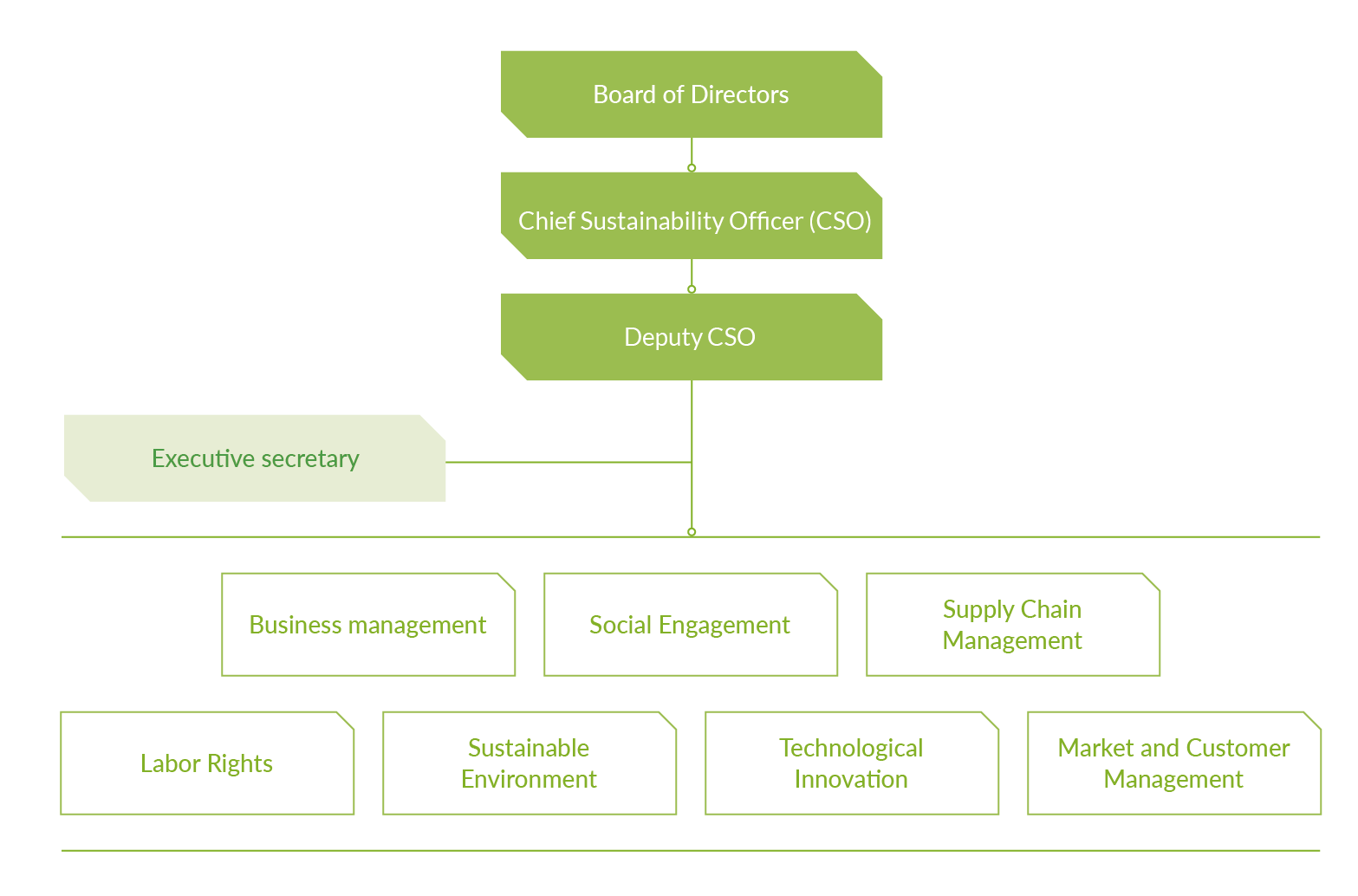
With the authorization of the Board of Directors, Chroma established the Chroma ESG Working Group in 2022, with 1.0 the Senior Vice President as the Chief Sustainability Officer (CSO) and reporting to the Chairman. As climate change issues involve a wide range of aspects, the Chroma ESG Working Group selected representatives from various departments according to functional units to participate in assessing risks and opportunities and discussing responses. Departments involved in the climate change assessment include: innovation and R&D, operations, production, procurement, finance, environmental safety and human resources departments. Division-level managers and above will participate in the discussion to help determine the impact of climate change on future market opportunities and company operations, the scale and frequency of the impact. They also develop responses to potential risks and take appropriate mitigation and adaptation actions while maintaining company operations.
Chroma implements appropriate action plans in response to key risks and opportunities, assigns follow-up responsibilities to relevant departments. Evaluation results are reported via the administrative management system. Relevant departments set KPIs for their respective work. Team members hold monthly progress tracking meetings to ensure all KPIs and work items are achieved. Director David Huang is responsible for supervising the Company's climate change strategy and targets, and reports the status and results of sustainable development to the Board of Directors twice a year.
Strategy
2-1 The ESG Working Group evaluated the 17 climate-related risks and 20 climate-related opportunities outlined in the TCFD framework based on Chroma's core measurement business and future market development. These risks were assessed in terms of their likelihood and urgency, categorized by short-, medium-, and long-term timeframes. The team conducted discussions and prioritization to develop a climate risk matrix.
Identification results and response measures of climate change-related risks
We classified climate change-related risk issues based on their magnititude and likelihood, and summarized the relative quantitative impact of these risk issues, along with the associated opportunities and response strategies. The climate risk matrix is prioritized by significance, as shown below:
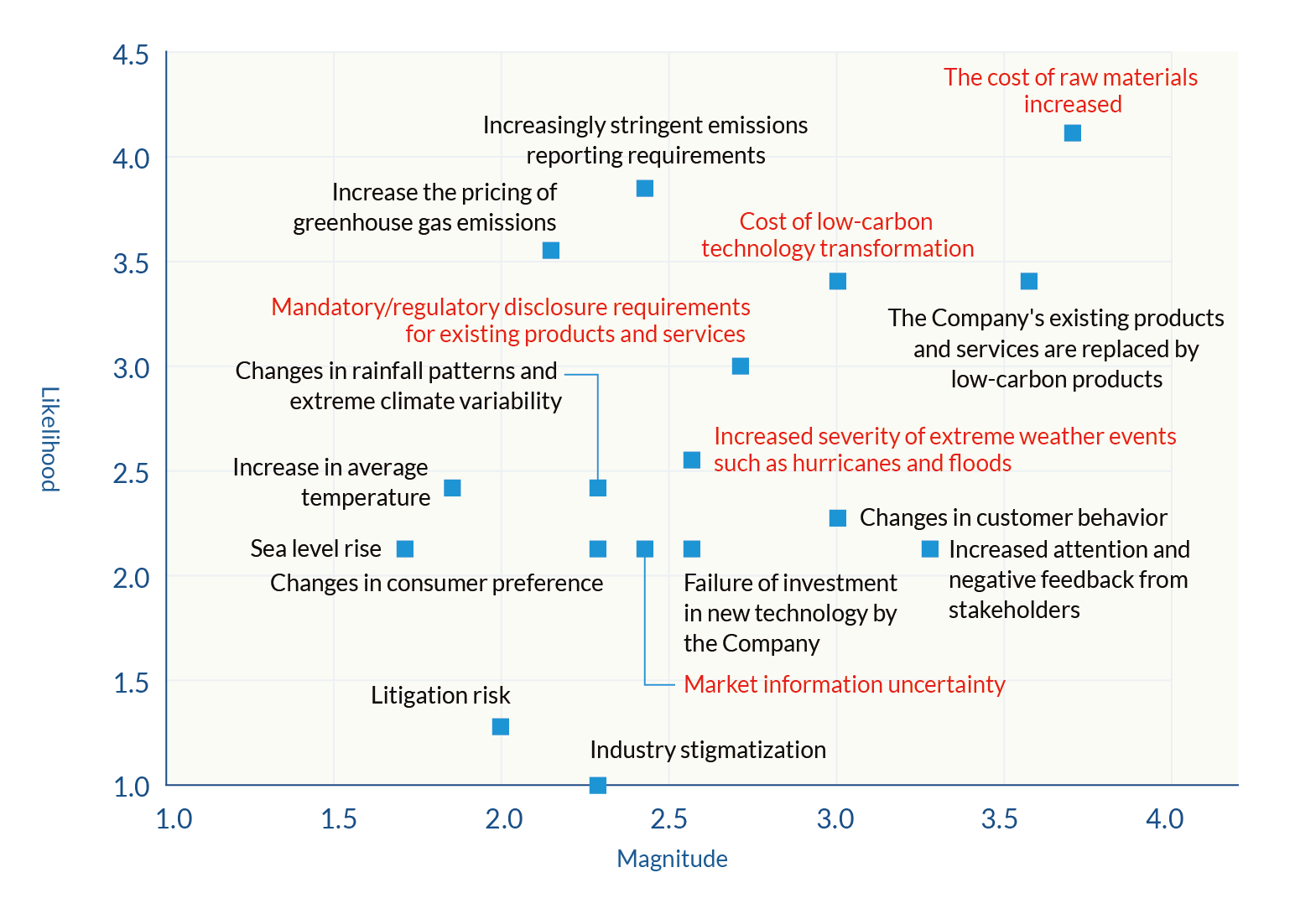
*Red text indicates short-term risks (1-3 years); others represent medium- to long-term risks (3-10 years).
To further assess the potential financial impact of climate change risks, the ESG Working Group used a risk matrix to prioritize and determine the most important climate-related risk issues, conducted relevant financial assessments, and developed corresponding response strategies. These initiatives aim to ensure business continuity and enable sustainable operations.
We have assessed the possible financial impact that the four types of transition risks and one physical risk may bring, as follows:
Transition risks
The cost of raw materials increased
Impact on Chroma
Because climate change has caused a shortage in the supply of raw materials, the demand for raw materials has exceeded the supply, which has led to an increase in procurement costs. This ultimately leads to an increase in manufacturing costs.
Subsequent financial calculation requirements
(1) The raw material items that may be affected and the extent of the impact
(2) Products and scope of impact
(3) The starting time shall be affected
Strategies
- R&D: Improve the use of shared materials, modularize products, design environmentally friendly materials, recyclable materials, and design energy-saving products and machines.
- Procurement: identification of green supply chains and requiring the top five suppliers by annual transaction amount to implement carbon reduction measures. Cardboard box and wooden pallet recycling: reused internally or returned to suppliers for "repeated use".
- Manufacturing: manufacturability planning, automated production, process improvement, and smart manufacturing.
Transition risks
Low-carbon technology transition
Impact on Chroma
The world has set a net-zero emissions target. After COP27, the world reached its carbon peak in 2025. Subsequently, the requirements for carbon reduction will become increasingly stringent, forcing the Company to adopt more low-carbon technology transformation developments, and may consider capital expenditures or overall improvements in technology, leading tohigher costs.
Subsequent financial calculation requirements
(1) The downstream fields are impacted.
(2) Cost of introducing low-carbon technology (capital expenditure).
(3) The overall cost increased due to the low-carbon technology (the increase in cost per unit).
Strategies
- R&D :Assess suitable low-carbon technologies
- Based on a product life cycle model, the Company drives product development toward higher efficiency, lower energy consumption, and enhanced sustainability.
Physical risk (Acute)
Extreme weather events such as hurricanes and floods
Impact on Chroma
Extreme weather increases the probability of hurricanes or heavy rains/floods, which may cause flooding in the factory area or nearby communities. After assessment, it was found that the factory site of the Guishan Plant of Chroma is located at a higher altitude, and the factory itself should not be affected too much, but the factory's external transportation may be hindered, resulting in reduced revenue or increased costs.
Subsequent financial calculation requirements
(1) Ongoing operational planning costs.
(2) Cost of alternatives.
Strategies
- Environmental safety: Assess the possible level of impact and formulate corresponding emergency response measures
Transition risks
The Company's existing products and services are replaced by low-carbon products
Impact on Chroma
If the Company does not grasp the technology for relevant low-carbon products, or if competitors' low-carbon products are launched first, the Company's market share may be eroded in the future, resulting in reduced revenue.
Subsequent financial calculation requirements
(1) Possible impact.
(2) Cost of alternatives.
Strategies
- R&D: Introduce new-generation green energy technology, lead market demand, and expand market share
- Market: Through brand projects, we collaborate with wellknown laboratories to strive to become a green product specification setter
Transition risks
Pricing of greenhouse gas emissions
Impact on Chroma
Under the broader target of net zero emissions, greenhouse gas emissions will be influenced by policies, including carbon pricing. Although the manufacturing process of Chroma is low-carbon emission, if greenhouse gas emission pricing increases, it will have a certain impact on the overall cost of the Company's products, leading to an increase in overall costs.
Subsequent financial calculation requirements
(1) Carbon pricing cost.
(2) Cost of alternatives.
Strategies
- We are currently actively planning internal carbon pricing and will make further plans after national policies are confirmed.
- At the end of 2024, Chroma signed a green electricity wheeling agreement. In 2025, actual green electricity consumption reached 912,988 kWh, accounting for 4.86%Note of total electricity consumption. To achieve its goals of "achieving net-zero emissions at office sites by 2030 and across all facilities by 2050," Chroma will increase its share of green electricity consumption annually, targeting an average annual growth rate of 5% and aiming to achieve RE30 by 2030.
Note: In 2025, the share of renewable energy did not meet the annual growth target of 5%, primarily due to a significant increase in overall electricity demand resulting from Chroma's expanded production capacity and operating scale. Chroma has steadily increased its procurement of green power and promoted self-generated renewable energy initiatives year over year to enhance renewable energy usage. However, the growth in total electricity consumption has outpaced the increase in renewable energy, thereby limiting the growth of renewable energy as a share of total consumption.
The development of a low-carbon economy will also support Chroma in accelerating the development of low-carbon products and technologies. According to assessments conducted by the ESG Working Group and the management team, the opportunities presented by climate change outweigh the associated risks for Chroma. Nevertheless, both opportunities and risks must be considered simultaneously, with a focus on expanding market opportunities.
Identification results and response measures for climate change-related opportunities
We classified climate change-related opportunities based on their magnitude and likelihood. The results are presented in the figure below. Chroma's team believes the greatest opportunities lie in climate-related opportunities associated with products and services, including research and development and innovation of new products and services, the development and/or expansion of low-carbon products and services, and business diversification.
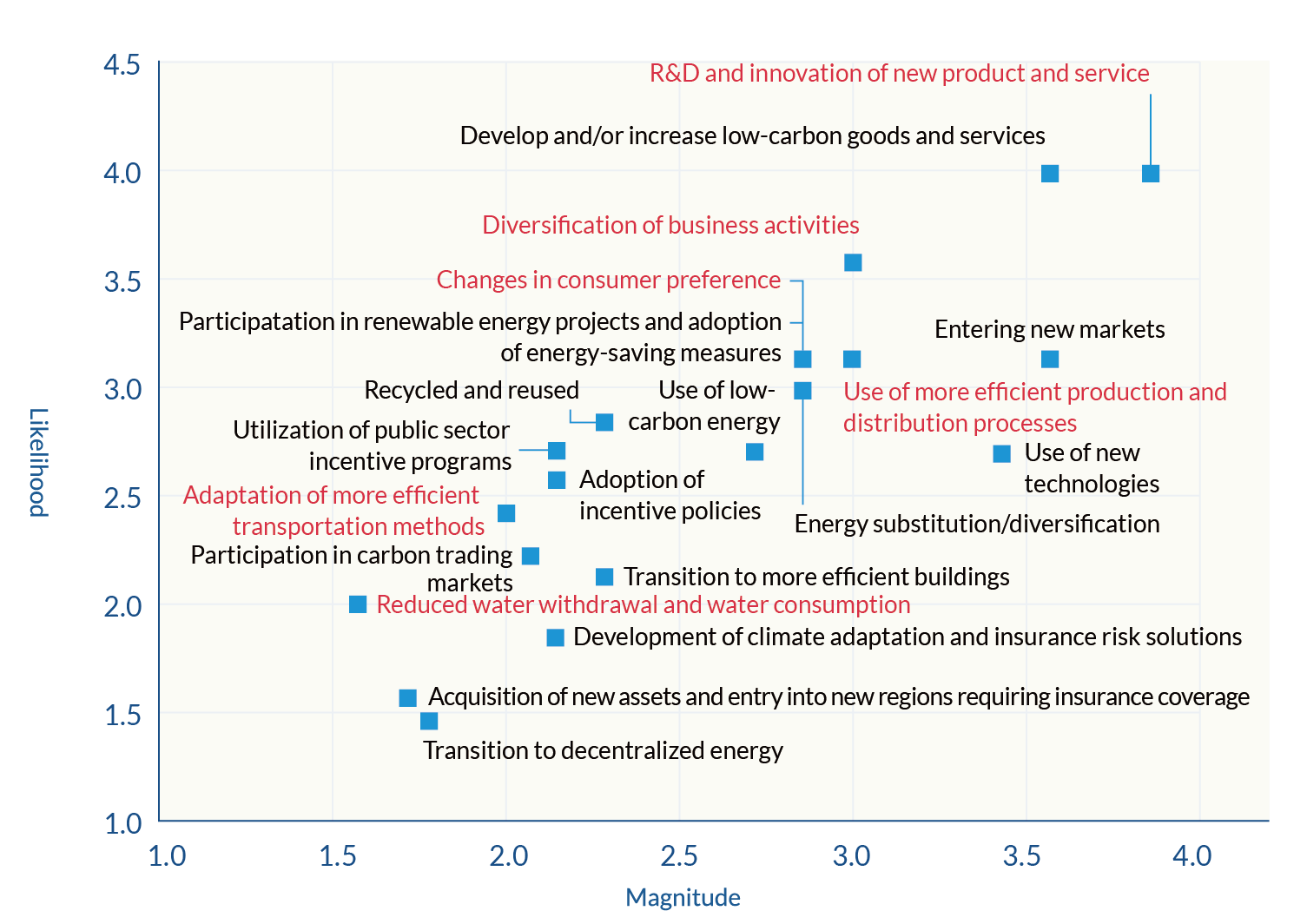
*Red text indicates short-term risks (1-3 years); others represent medium- to long-term risks (3-10 years).
We have assessed the possible financial impact that the three types of transition opportunities may bring, as follows:
Subsequent financial calculation requirements
Forecast the speed of new product launch by downstream markets
Strategies
- Market: Study the product demands of each new market, and re-investigate and collect the material and equipment suppliers required by the new market.
(1) Designated personnel is responsible for market analysis of new markets.
(2) The product manager of the business unit precisely understands customer needs.
Subsequent financial calculation requirements
Average revenue of existing/new customers
Strategies
- Recruit R&D personnel with relevant technologies
- Formulate marketing strategies and after-sales service plans for new markets
- Cultivate/recruit marketing talent for new markets
- Plan a comprehensive after-sales service system to meet the needs of new markets
- Participate in communication protocol development organizations to understand new generation communication standards and set future technology development goals
- Improve the accuracy and coverage of SI analysis simulation to reduce the development and testing time of practical measurement systems
- Introduce academic consultants to accelerate the learning curve
- Based on the Company's existing products and technologies as a stepping stone, we try to enter new markets that the Company has never touched before, such as green energy industry, electric vehicles, semiconductors, etc., and understand customers' testing pain points
Subsequent financial calculation requirements
Number of new customers, Number of new products
Strategies
- R&D: Introduce new-generation green energy technology, lead market demand, and expand market share
- Evaluate the development needs of both standard and customized products, and formulate R&D strategies in response to market demand
Risk Management
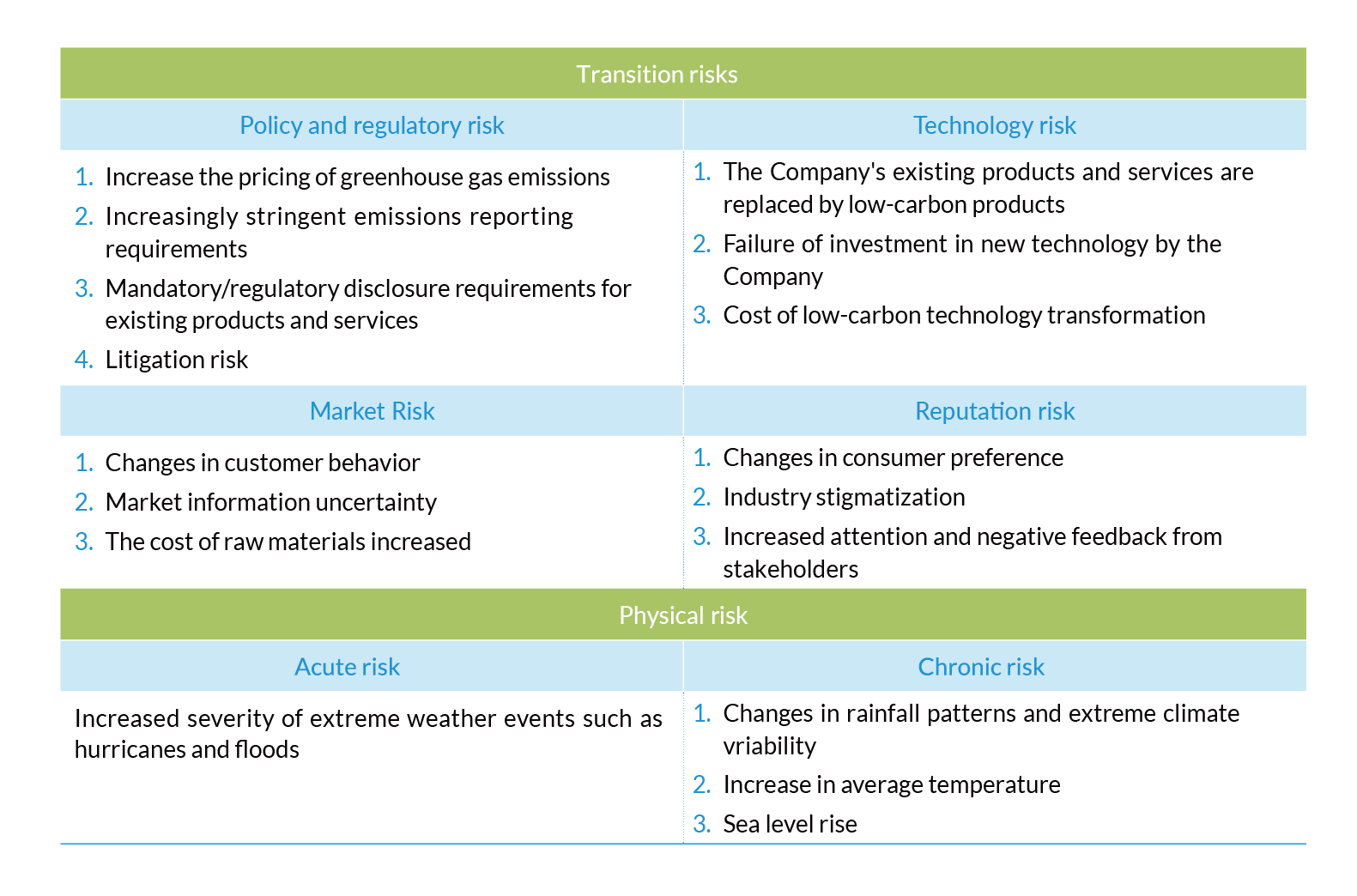
3-1 In order to assess climate-related risks, Chroma's ESG Working Group referred to the TCFD Guidelines, the Global Risk Report, and the Taiwan Climate Change Research Report for 2050. Taking into consideration the actual conditions of its operating markets, the team conducted a comprehensive assessment of both transition risks and physical risks as outlined in the TCFD framework.
3-2 After the first TCFD report was released by the ESG Working Group in 2022, the Company adopted an annual risk assessment approach to manage the currently identified climate-related
risks and opportunities. Following reporting to the Board of Directors, the results will be disclosed in the corporate sustainability report.
3-3 Response measures have been developed for four major transition risks, including rising raw material costs, the transition to low-carbon technologies, the replacement of existing products and services with low-carbon alternatives, and greenhouse gas emissions, as well as one significant physical risk, which is extreme weather events such as hurricanes and floods.
To assess climate-related risks, the ESG Office referred to the TCFD Guidelines, the Global Risks Report, and the Taiwan Climate Change Research Report for 2050. Taking into account the Company's actual operating conditions, it separately evaluated the 13 transition risks and four physical risks identified in the TCFD framework.
In terms of risk management procedures, we conduct identification and analysis annually, integrate climate change issues into environmental risks, and incorporate them into our corporate risk management system.
We adopted a matrix assessment approach, evaluating various factors based on the "probability of occurrence" multiplied by the "potential impact" (using a 0-5 scale to indicate low, medium, and high levels). The ESG Working Group considered the actual conditions of each customer. Following an internal control review, issues are prioritized and categorized by "urgency" (including short-, medium-, and long-term horizons).
Chroma completed its ISO 14064-1:2018 greenhouse gas inventory in 2021. In 2022, the Company initiated TCFDaligned climate-related financial assessments and published its first report. We will implement strategies for identified risks and opportunities across functional departments, establish specific reduction management procedures, and ensure we understand and monitor changes through annual risk assessments. In the future, we will proactively set science-based targets (SBTs).
Metrics and Targets
4-1 Based on the above strategies and risk management processes, the ESG Working Group has identified corresponding measures that require immediate action. Each year, we will implement a quantitative tracking and management mechanism for each of the above indicators.
4-2 For greenhouse gas emissions, 2021 is defined as the base year, with the scope covering Scope 1 and Scope 2. We have also set the target of "achieving net-zero emissions at office sites by 2030 and across all facilities by 2050". The Company completed thirdparty verification of greenhouse gas emissions in accordance with ISO 14064-1 in 2021 (which also serves as the base year), and will continue to collect carbon emission-related data in accordance with the established methods to ensure the accuracy of greenhouse gas emissions. We regularly disclose data related to greenhouse gas emissions in our
sustainability reports and communicate this information with stakeholders.
4-3 In light of the global wave of net zero emissions and the carbon border mechanisms in Europe and the US, the transition to net zero is no longer an environmental issue; it is an economic issue critical to the international competitiveness of companies. The industry continues to promote the deployment of green energy, bringing business opportunities in
smart cities, smart transportation, smart grids, and energy storage. Chroma offers testing solutions across various green energy technology sectors and has received repeated recognition from leading international manufacturers. Leveraging its innovation in measurement technology, the Company has developed a range of energy recovery testing solutions to meet global green initiatives. These solutions not only help customers save on
high electricity costs but, more importantly, reduce carbon emissions, thereby driving and accelerating the industry's transition to net zero. Looking ahead, Chroma will continue to focus on developing low-carbon products that enhance user benefits and provide customers with a broader range of solutions. In 2023, following the release of Chroma's first Climaterelated Financial Disclosures (TCFD) report, the Company established management targets, formulated response strategies and action plans, and began systematically disclosing the progress and outcomes of these climate-related efforts.
4-4 At the end of 2024, Chroma signed a green electricity wheeling agreement with a renewable energy provider. The agreement is expected to supply 900 thousand kWh of green electricity in the first year, accounting for 5% of the Company's total electricity consumption. Starting in 2025, Chroma plans to increase the proportion of green electricity by an average of 5% each year, aiming to achieve RE30 by 2030.
Based on the above strategies and risk management processes, the ESG Working Group has identified the corresponding measures that require immediate action and the indicators to be tracked in the future as follows:
Strategies
- R&D: Improve the use of shared materials, modularize products, design environmentally friendly materials, recyclable materials, and design energy-saving products and machines.
- Centralized procurement: identification of green supply chains and requiring the top five suppliers by annual transaction amount to implement carbon reduction measures.
- Manufacturing: Design for manufacturability, automated production
Metrics and Targets
(1) Track and improve energy saving rates.(2) Implement supplier environmental risk assessments and set supply chain carbon reduction targets.
Chroma has established quantitative tracking and management mechanisms for key indicators, continuously monitored and optimized by relevant departments.
In terms of greenhouse gas emissions, we have set net zero emissions by 2050 as our net zero target. Through third-party verification of ISO14064-1:2018 greenhouse gas emissions, the Company will continue to collect carbon emission related data in accordance with the established methods to ensure the accuracy of greenhouse gas emissions. We regularly disclose data related to greenhouse gas emissions in our sustainability reports and communicate this information with stakeholders.
In light of the global wave of net zero emissions and the carbon border mechanisms in Europe and the US, the transition to net zero is no longer an environmental issue; it is an economic issue critical to the international competitiveness of companies. The industry continues to promote the deployment of green energy, bringing business opportunities in smart cities, smart transportation, smart grids, and energy storage. Chroma offers testing solutions across various green energy technology sectors and has received repeated recognition from leading international manufacturers. Leveraging its innovation in measurement technology, the Company has developed a range of energy recovery testing solutions to meet global green initiatives. These solutions not only help customers save on high electricity costs but, more importantly, reduce carbon emissions, thereby driving and accelerating the industry's transition to net zero. Looking ahead, Chroma will continue to focus on developing low-carbon products that enhance user benefits, take on a "carbon handprint" role within the supply chain, and provide customers with a broader range of solutions.